



Frederik Wouters Keynote Frames AI as Response to Drupal Decline

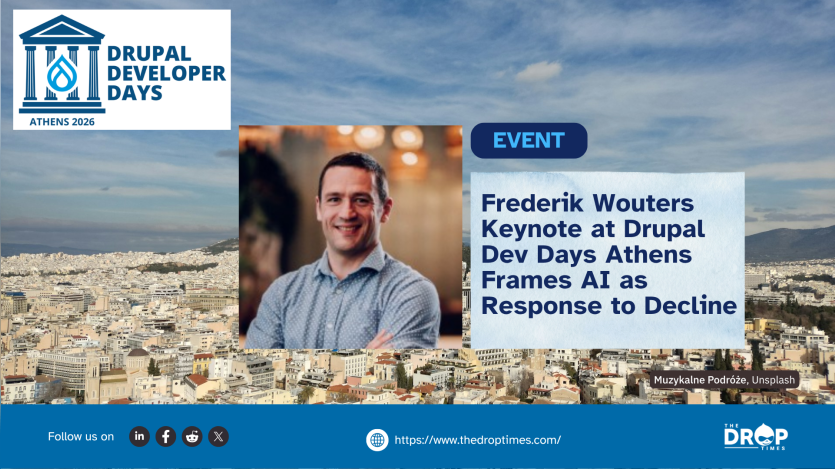
Frederik Wouters delivered a keynote at Drupal Dev Days Athens 2026 outlining artificial intelligence as a response to declining Drupal adoption and introducing a direction described as “Autonomous Drupal.”
The presentation opened with ecosystem data establishing the context. Drupal has lost 190,000 installs over the past three years, averaging 173 per day. This decline was used to frame the need for structural change, with artificial intelligence positioned as a potential mechanism to stabilise and expand adoption.
The keynote also outlined the current state of the Drupal AI Initiative. As of April 2026, it reports $1.4 million in funding, 34 Makers, and ten teams contributing an estimated 22.5 full-time equivalents. More than 100 individuals are involved, and the AI module has reached 6,572 installs, growing by 259 installations per week, indicating early momentum.
Version 2.0 of the AI module was described as an abstraction layer designed to integrate multiple providers and workflows, reflecting broader architectural patterns across adjacent ecosystems. At the same time, some submodules have separated from the core project, indicating early-stage diversification within the tooling landscape.
A revised Drupal Flywheel model was introduced to frame growth strategy, focusing on reducing migration friction, improving the editorial experience, and increasing the visibility of Drupal use cases through community storytelling. These elements were presented as interdependent drivers of user acquisition and retention.
The keynote also outlined a longer-term concept described as an “Autonomous Content Framework,” proposing systems capable of ingesting external information, generating structured drafts, and routing them through validation workflows, with human oversight at key decision points.
The session included a live demonstration of an AI assistant referred to as “Bruce,” developed within Dropsolid’s platform integrations. The demonstration showed content being generated and published during the keynote using real-time inputs across connected systems.
The presentation combined measurable progress in funding, participation, and module adoption with forward-looking concepts, positioning the initiative as an evolving response to ecosystem challenges.
ASK: Drupal Community Needs Your Support
View all →
Note: The vision of this web portal is to help promote news and stories around the Drupal community and promote and celebrate the people and organizations in the community. We strive to create and distribute our content based on these content policy. If you see any omission/variation on this please reach out to us at #thedroptimes channel on Drupal Slack and we will try to address the issue as best we can.

Related Drupal Initiatives

Related Events


Related Organizations

Related People


You may also like