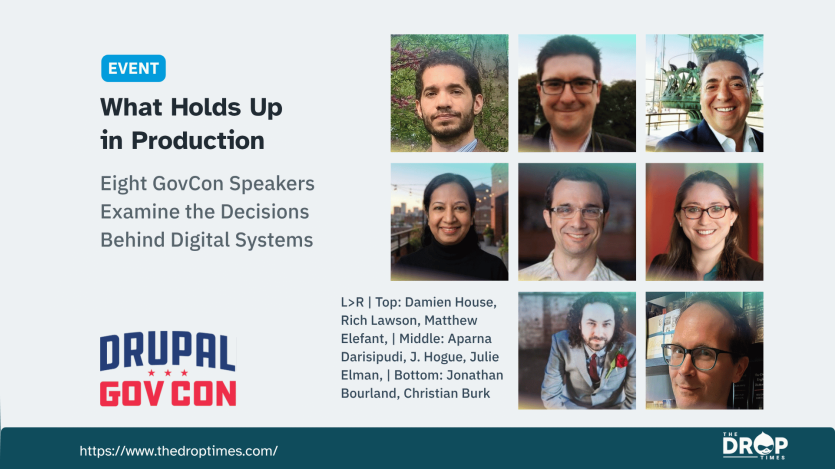
Eight Drupal GovCon 2026 speakers who responded to <cite>The Drop Times</cite> are examining agent orchestration, bot protection, accessibility, AI decision-making, search, and migration across six sessions. Their responses describe the practical problems behind the sessions and the decisions they want attendees to carry into Drupal and public-sector work. The speakers featured here are drawn from material supplied to The Drop Times rather than the complete conference programme.
This second speaker preview follows The Drop Times’ first GovCon 2026 speaker preview. It includes responses that were not part of that earlier package.
Get the Latest in Drupal!
Produced by Drupal4Gov, Drupal GovCon runs from 11–13 August 2026 at the Stamp Student Union at the University of Maryland, College Park. Tuesday was devoted to training before the main session programme across Wednesday and Thursday. The official programme provides the current schedule and room assignments, while the responses supplied to TDT add the speakers’ reasons for choosing their subjects, intended takeaways, and expectations for the event.
Damien House, founder and CTO of 109.studio and a principal architect, is approaching AI through the infrastructure surrounding an agent rather than through a demonstration of model capability. His session, Anatomy of an Agentic Harness: Building the Same Agent in Drupal AI, LangChain, and CrewAI, holds one small Drupal task, dataset, model, tools, validation process, and human-review destination steady while rebuilding the orchestration three ways.
According to the GovCon programme, the comparison uses a task involving Drupal pages with missing image alt text and recommendations prepared for editor review. It examines six parts of the agent harness: context, tools, memory, verification, human review, and failure recovery. The programme describes different strengths across the three implementations, including Drupal AI’s role-based approvals and revisions, LangChain’s tool breadth and prototyping speed, and CrewAI’s multi-agent roles, while also identifying open questions around verification, safety tooling, and prompt injection.
Damien House
Damien House
I’m excited to get beyond “look what AI can do” and talk about how we make these systems reviewable, permission-aware, recoverable, and useful in Drupal production.
–Damien House, founder and CTO, 109.studio
Damien said the purpose is not to survey frameworks in the abstract but to expose where those operational responsibilities actually live when the same task is implemented three ways. He wants attendees to leave with a six-part checklist that can be applied to other agent stacks. His broader interest at GovCon is in discussing the practical requirements that determine whether agentic systems can be operated safely and reliably after a demonstration ends.
Rich Lawson, associate director of technology at Evolving Web, is focusing on automated traffic and Drupal site stability. His session, Surviving the Swarm: Bot and Crawler Protection for Drupal Sites, examines aggressive scrapers, AI crawlers, Drupal contributed modules, and infrastructure-level defences. Rich said the material is intended for Drupal developers, site builders, and DevOps engineers responsible for keeping sites available under pressure.
Rich Lawson
Rich Lawson
For the why, it's because the latest AI crawlers have been really aggressive, and they can easily overwhelm site infrastructure and bring down your site.
–Rich Lawson, associate director of technology, Evolving Web
Rich’s LinkedIn post about the session describes the failure case as uncontrolled bot traffic consuming available resources. He plans to review contributed modules that limit or block traffic and then examine Web Application Firewalls and other defensive tools. The session will use real implementations to discuss measures that worked, measures that did not, and the reasons behind those outcomes.
The intended takeaway is an actionable playbook for responding to bot traffic rather than reliance on a single module or infrastructure product. Rich said he is also looking forward to meeting new people, reconnecting with community members, attending Birds of a Feather discussions, and taking part in the conference’s social events.
Matthew Elefant, managing director of Inclusive Web, is approaching accessibility through the difference between knowing standards and experiencing a website through assistive technology. His session, Navigating the Digital Realm: A Journey Through the Eyes of a Screen Reader User, asks attendees to consider how much context sighted users receive from layout, spacing, images, headings, navigation, and page structure. Matthew said accessibility practitioners may understand technical requirements without often seeing how someone who relies on a screen reader actually encounters a site.
The session uses an interactive exercise called “Guess That Site,” in which attendees navigate real web experiences using information delivered through a screen reader. Matthew wants the exercise to expose both the difficulty created by inaccessible implementation and the points at which accessible structure and content allow a person to understand and use the page. The official session description similarly centres firsthand experience with screen-reader navigation.
Matthew Elefant
Matthew Elefant
My hope is that attendees walk away with a better understanding of accessibility from the user’s perspective, not just what it means to pass a test or meet a guideline. When you experience the difference firsthand, accessibility becomes much more tangible.
–Matthew Elefant, managing director, Inclusive Web
Matthew frames that experience as a way to connect knowledge of accessibility standards with what those requirements mean for the person using the resulting interface. He said he is also looking forward to meeting Drupal and government practitioners working on more inclusive digital services and learning from their experience.
Aparna Darisipudi, a federal strategist and systems leader, is focusing on responsibility when organisations are under pressure to adopt AI quickly. Her session, The Approval Seat: Weighing AI Trade-offs Under a Move-Fast Mandate, centres on programme managers, digital leads, and subject-matter experts who may be responsible for approving AI-enabled work without building the underlying systems themselves. Aparna describes the session as practical literacy for deciding what AI can take on and what judgement must remain with the person accountable for the result.
The session follows Aparna’s workshop, Mis-Classified — Who Owns What Your Content Means?, and an earlier Mis-Classified article. Those materials argue that organisations often lack clear ownership over taxonomy, controlled vocabulary, information architecture, and the authority to decide what content means. Aparna connects that governance problem to AI because a system may still generate an answer when the organisation itself has not settled which information or definition is authoritative.
Aparna Darisipudi
Aparna Darisipudi
Both sessions are about the people side of AI adoption: the judgment, the ownership, and the decisions that don't have an obvious home.
–Aparna Darisipudi, strategist and systems leader
The Approval Seat moves from ownership of that foundation to the individual who must approve a specific AI-enabled outcome. The official session description places the person responsible for the human review at the centre of the problem: someone still has to decide whether an output is trustworthy, whether a use case is appropriate, and what good performance means for the mission. Aparna wants attendees to leave with questions that help non-technical decision-makers evaluate those trade-offs and understand what they are agreeing to own.
Aparna said she is most interested in what she calls the seams, where technical work meets a decision and a mandate reaches the people responsible for delivery. Her argument is that faster automation does not remove decision weight from those people and may instead increase it. She wants federal practitioners to discuss those situations using problems they are already facing rather than hypothetical AI scenarios.
J. Hogue, director of experience design at Oomph, Inc., will present Humanizing AEO/GEO: How Accessibility Influences the Agent Experience with Julie Elman, senior digital project manager at Oomph. Hogue said the session is intended in part for people who have not kept pace with changes in search over the past year and want to understand what organisations can do now. His framing centres on how agentic and AI-supported search changes the way content is discovered.
J. Hogue
J. Hogue
Discoverability is moving from the position to the passage.
–J. Hogue, director of experience design, Oomph, Inc.
Hogue said the session will spend less time recapping terminology and more time on actions organisations can take using practices they may already have. He points to accessibility and content strategy as foundations that can support newer forms of discovery, particularly where clear structure and meaningful content help systems identify useful passages. The presentation will also cover tools that marketers and content managers can use to monitor how content performs as search behaviour changes.
Julie Elman, senior digital project manager at Oomph, adds a content-management and accessibility perspective to the same session. She said her team is seeing changes in how audiences reach digital content as AI agents and AI-powered search become part of the discovery landscape.
Julie Elman
Julie Elman
We’re seeing consistent declines in traditional organic traffic alongside a corresponding increase in traffic and discovery through AI agents and AI-powered search.
–Julie Elman, senior digital project manager, Oomph, Inc.
Julie therefore argues that organisations need to understand visibility across both traditional search and emerging AI-supported channels rather than treating the latter as a separate content problem. Losing visibility across those channels, she said, can affect engagement and conversions.
She also points to an overlap between established accessibility work and content that can be interpreted effectively by AI-driven systems. The session will discuss well-structured, plain-language, regularly refreshed content and practices familiar from WCAG 2.2, along with tools teams can use to monitor changing discovery patterns. Julie said she is also looking forward to reconnecting with people from her first Drupal GovCon and exchanging ideas with others working through the same changes.
Hogue said he is particularly interested in audience questions about what concerns organisations, where teams are getting stuck, and what they have already tried. The programme similarly presents the joint session as a practical response to changing discoverability rather than simply a review of AEO and GEO terminology.
Christian Burk, back-end engineer at CivicActions, and Jonathan Bourland, associate director of Drupal and Python practice area lead at CivicActions, are presenting I’m Picking up Good Migrations: High-Fidelity Site Consolidation with Drupal AI. Their response to The Drop Times places the session against a longstanding public-sector problem: government organisations often have large collections of websites that have become difficult to maintain, consolidate, or move as requirements and organisational structures change.
The session focuses particularly on consolidating content from multiple legacy properties into Drupal without reducing complex source material to a single unstructured body field. The official GovCon programme describes that shortcut as an “extract-and-dump” approach that can undermine content flexibility, search, SEO, and later redesign work. Instead, the presenters are exploring how Drupal AI Migration can use a defined Drupal content model as the target structure for AI-assisted parsing of legacy material.
In their response to TDT, Bourland and Burk said the AI Migration module is being developed on top of Drupal AI to help large language models organise legacy content into structured Drupal fields. Bourland described the problem of consolidating disparate properties as difficult and resource-intensive, while arguing that the module can reduce some of the manual work involved in moving complex legacy sites into Drupal.
Jonathan Bourland
Jonathan Bourland
Our module facilitates the responsible, practical use of AI with humans in the loop in order to make difficult migrations faster, cheaper, and easier. We keep people doing what they’re good at, and AI doing what it’s good at: organizing 1000s of pages into complex taxonomies, media, and content types.
–Jonathan Bourland, associate director of Drupal and Python practice area lead, CivicActions
Bourland’s comments frame the system as a division of labour rather than an attempt to remove people from migration decisions. The presenters say AI can assist with organising large volumes of material while people retain responsibility for reviewing the resulting structures and migration outcomes. Bourland also said the approach is intended to support compliance and security requirements. Claims that the module can make migrations faster, cheaper, easier, or less error-prone remain stated goals of the presenters rather than independently established performance results.
The programme adds a technical constraint to that approach: the model is not asked to invent the destination architecture. Instead, Drupal supplies a target schema based on designed content types, giving the AI a defined structure into which legacy HTML can be parsed. The intended result is a structured Drupal content model rather than a bulk transfer of source pages into undifferentiated HTML fields.
Christian Burk
Christian Burk
While we are excited to share the work that we have done, we are even more excited to hear from stakeholders and learn about their digital challenges. And we are always interested in learning from other CivTech developers and finding ways to collaborate.
–Christian Burk, back-end engineer, CivicActions
Burk’s emphasis places the session within the wider civic-technology conversation rather than presenting Drupal AI Migration as a finished answer to every consolidation problem. He said the presenters want to hear directly from government stakeholders about the migration and modernisation problems they are encountering and to compare their work with approaches being developed elsewhere in the CivTech community.
Across the eight respondents, the speakers address different points at which technical capability meets an operational constraint. Damien compares where control and recovery live inside agent frameworks; Rich focuses on infrastructure under automated traffic; Matthew examines accessibility through the user’s experience; Aparna addresses responsibility for AI-assisted decisions; Hogue and Julie look at changing content discovery; and Bourland and Burk examine structured migration with Drupal AI. The subjects differ, but each asks what teams must still understand, review, or maintain after automation and tooling enter production work.
Drupal GovCon continues through 13 August 2026 with sessions beyond the speakers featured in this preview. This article does not attempt to represent every presentation on the programme, including sessions from speakers who did not provide responses for this series. Readers can consult the Drupal GovCon 2026 programme for the current schedule, room assignments, and further conference information.
I lead engagement and interaction with the Drupal community in TDT
Image Attribution Disclaimer: At The Drop Times (TDT), we are committed to properly crediting photographers whose images appear in our content. Many of the images we use come from event organizers, interviewees, or publicly shared galleries under CC BY-SA licenses. However, some images may come from personal collections where metadata is lost, making proper attribution challenging.
Our purpose in using these images is to highlight Drupal, its events, and its contributors—not for commercial gain. If you recognize an image on our platform that is uncredited or incorrectly attributed, we encourage you to reach out to us at #thedroptimes channel on Drupal Slack.
We value the work of visual storytellers and appreciate your help in ensuring fair attribution. Thank you for supporting open-source collaboration!
Disclosure: This content is produced with the assistance of AI.
Note: The vision of this web portal is to help promote news and stories around the Drupal community and promote and celebrate the people and organizations in the community. We strive to create and distribute our content based on these content policy. If you see any omission/variation on this please reach out to us at #thedroptimes channel on Drupal Slack and we will try to address the issue as best we can.














 Ben Peter MathewI lead engagement and interaction with the Drupal community in TDT