



Inside the Drupal AI Demo: Testing the Northmoor University Site

During the keynote demonstration at DrupalCon Rotterdam 2026, an editor asked an outside assistant to update every page that mentioned a newly promoted professor. The assistant found ten pages and drafted the changes, but published nothing: each draft waited for a person to review and publish it.
Dries Buytaert, Drupal's founder, gave that keynote on 29 September 2026 and showed "Drupal AI Demo: Northmoor University", a fictional university website from the Drupal AI Initiative with Drupal's AI features already configured. Anyone can launch a copy from the Drupal AI Demo page on Drupal.org.
Christoph Breidert, product lead for Drupal AI, wrote in his announcement on 30 September 2026 that the demo's features "all run together on the same site and the same content". For agencies and site owners, it shows how the initiative's modules are meant to be combined and where people, rather than AI, make the final decision. The foundational modules have stable releases, while several of the newer ones, including MCP Server, are still pre-release.
A Fictional University with a Real AI Configuration
Northmoor University is fictional, but its content and AI configuration are real and functional within the demo. The site holds the kind of material a university publishes: programmes, courses, people, news, events and policies.
The demo was built by the Inside AI team, led by Christoph. Most of the work was done by Marcus Johansson, Artem Dmitriiev, Aidan Foster and Christoph, with contributions from the Drupal AI Partners, the organisations that fund and staff the initiative, and the wider community. By Christoph's count, between 1 August and 26 September 2026, more than 100 people contributed code, reviews or merge requests. Their work included 1,442 commits across 54 projects and 616 merge requests merged on Drupal.org.
Each Copy Is Free, with AI Credits Included
The launch buttons on the Drupal.org demo page lead to Drupal Forge, which creates a separate copy of the site for each visitor after a short arithmetic bot check. Drupal Forge is a community platform built on DevPanel and managed by OPS Association, a Colorado nonprofit. Drupal.org lists Drupal Forge among the Silver partners of the Drupal AI Initiative.
No payment card is needed, and each copy comes with a free trial allowance of AI credits. When the allowance runs out, the AI features stop answering until the visitor buys more credits from amazee.ai or connects an AI provider of their own. The official demo page advertises a 30-day trial, while the expiry of an individual instance is shown in its Drupal Forge launch information.
The DropTimes launched a copy and followed parts of its feature guide, signed in as the demo's administrator. The site is available in English and Spanish, and the guide walks through each feature, from comment moderation and content review to image checks, Spanish translation, page building in Drupal Canvas, observability and metering. It also includes pages on getting started and adding AI credits or an AI key.
Guardrails, Logging and Model Choice Sit Underneath the Features
In the written version of his keynote, Dries said the foundation underneath the features excites him most. He described Drupal AI as turning Drupal into "an AI harness". Organisations can connect AI models to structured content, tools and workflows while retaining control through permissions, guardrails, observability, metering and a choice of AI models.
The demo applies those ideas to one site: "AI guardrails, one source of truth and every interaction logged", in the initiative's words. Its observability feature forwards routing, cost and performance data to an organisation's existing monitoring tools.
Guardrails are checks that run before and after a model generates a reply. The AI module's documentation says they "can pass, stop, or rewrite content based on your rules". The AI 1.5.x documentation lists five built-in guardrails covering input length, moderation, regular-expression matching, topic restrictions and sensitive-content filtering.
Answers Come from the Site's Own Pages, with Sources Listed
Visitors can ask the site questions in plain language and get answers drawn from its own content, with the sources listed. A question the content does not cover is marked out of scope, with a pointer to the appropriate person to contact. The system "is not allowed to invent an answer", according to the Drupal AI Initiative's description of the demonstration.
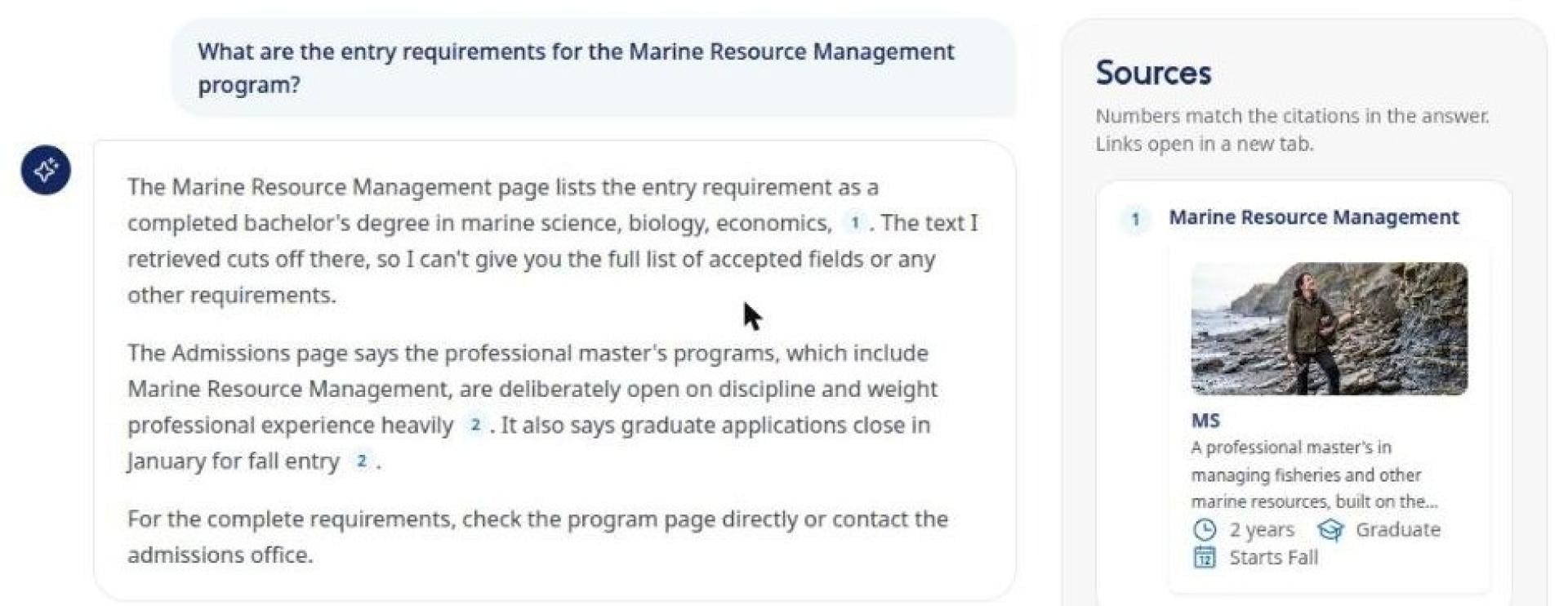
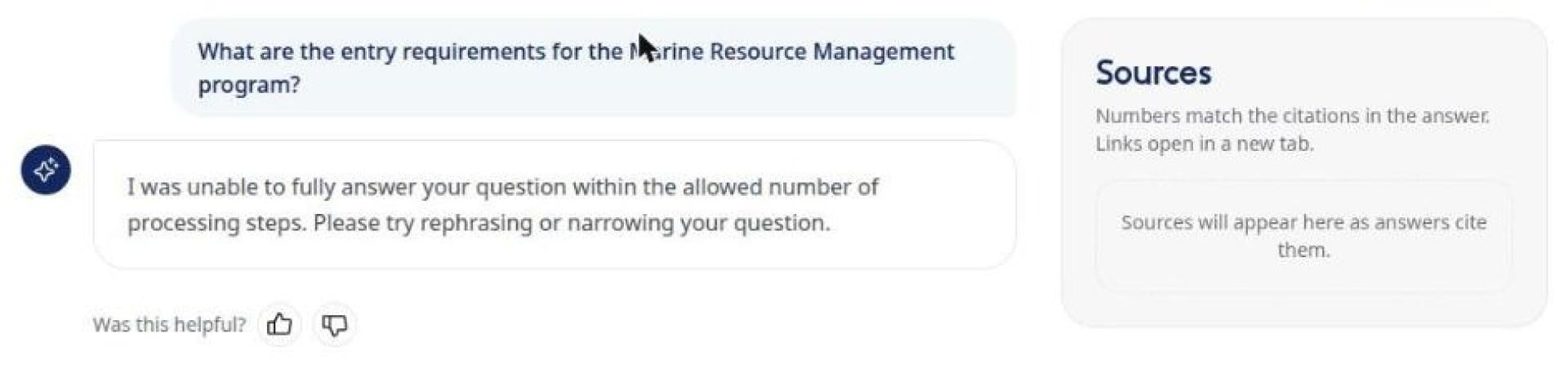
Asked about the entry requirements for a fictional master's programme in Marine Resource Management, the site on one of The DropTimes' copies answered with two cited pages: the programme page and the admissions page. The response also noted that the programme text it had retrieved "cuts off".
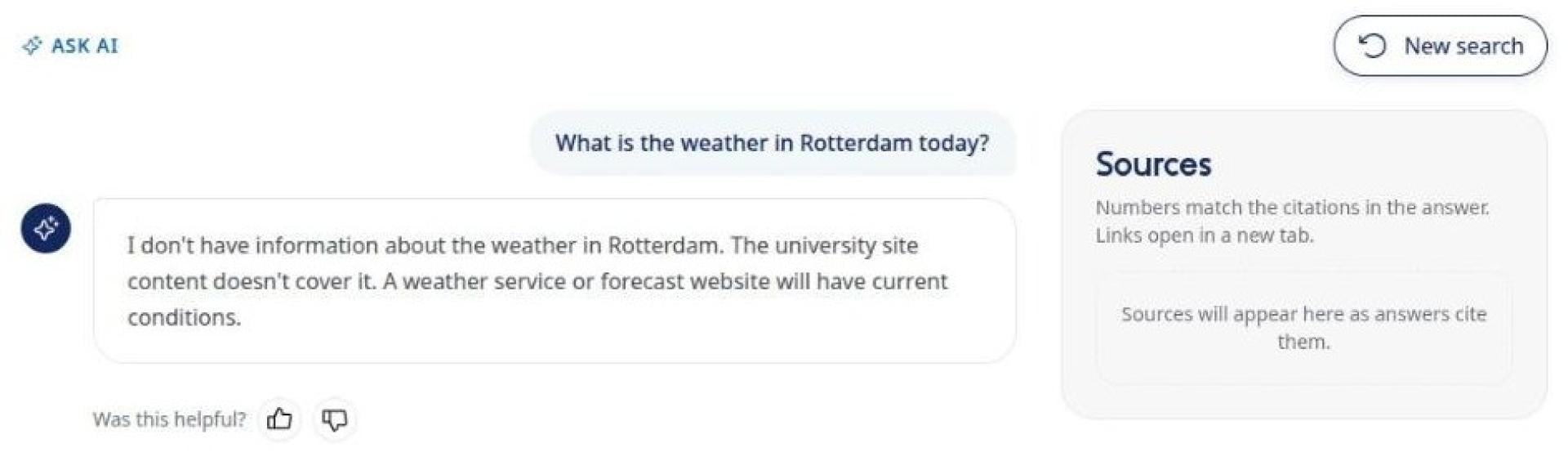
A question about the weather in Rotterdam received no invented answer. The site replied that it did not have that information, that the university site's content did not cover it and that a weather service would have current conditions. No sources were cited.
When the processing-step limit is reached. The agent that writes the answer has a limit on processing rounds. A question that requires more gets no partial answer: the site replies that it could not answer "within the allowed number of processing steps" and asks for a narrower question. On another of The DropTimes' copies, the same entry-requirements question produced that response repeatedly. The message is the AI Agents module's default, and site builders can change it in the agent settings.
Outside Assistants Work Through the Editor's Own Account and Permissions
Editors can also connect an outside assistant such as Claude or ChatGPT through the Model Context Protocol (MCP). The MCP Server module exposes the site's configured tools, resources and prompts to the assistant, which can then interact with Drupal from outside the website.
In the demonstrated workflow, edits made this way go through the editor's account, appear in each page's revision history and are limited by that editor's role and permissions. The DropTimes' guide to AI coding agents on Drupal projects covers the MCP connection from a developer's perspective. MCP Server has no supported stable release, so the Drupal Security Team's advisory coverage for stable releases does not yet extend to it.
Six More Features Work on the Same Content
The demo's other features include:
- Page building: An editor describes a page, and an agent assembles it from the site's own components.
- Translation: One-click Spanish translations through the AI Translate module and Drupal's Translation Management Tool. Translated pages wait for review and publishing.
- Content classification: New content is tagged against the site's taxonomy, and the team approves the tags.
- Image checks and generation: Object detection checks that uploaded images show what they should. Images can also be generated from text prompts, with alt text produced automatically.
- AI disclosure: AI-generated content is labelled to support transparency. Article 50 of the EU AI Act includes disclosure obligations for certain AI-generated text published to inform the public on matters of public interest, with exceptions that include substantive human review or editorial control where a person or organisation holds editorial responsibility. On the launched copy, an AI-written story carried a machine-readable label in its HTML but no visible notice on the page. That observation alone does not establish whether a public-facing disclosure was legally required for that particular content.
- Comment moderation: Personal attacks are blocked automatically, and comments are checked for relevance.
Content Review Scores a Page and Suggests Rewrites
Content review scans existing pages against criteria such as accuracy, brand voice, legal requirements, inclusive language and reading level, and returns specific suggestions for editors to act on. While a draft is being written, editor assistants can propose titles, copy edits and social media summaries.
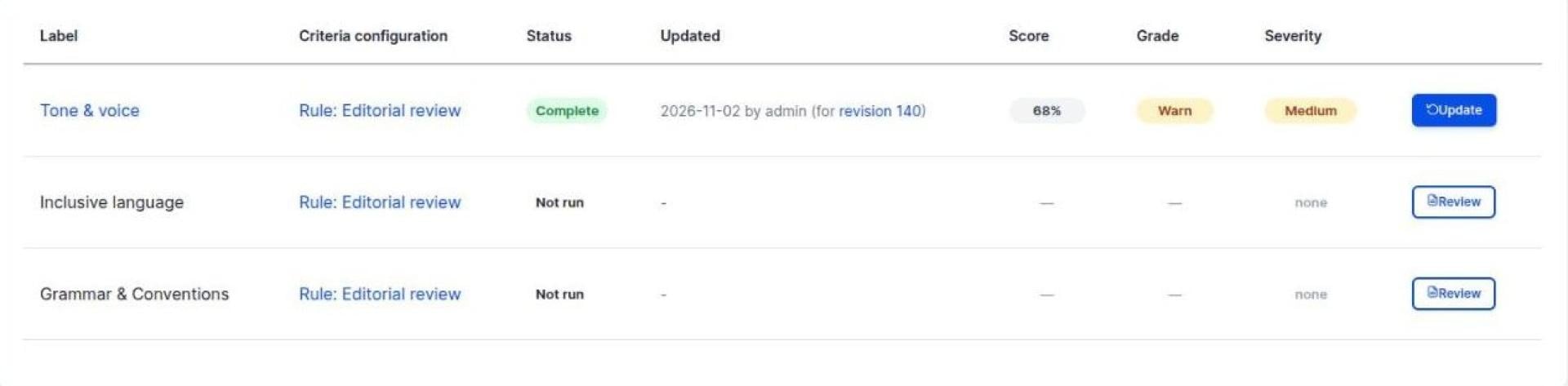
On the launched copy, a sample page, "Account Setup Information", was run through the tone and voice check. This was one of three criteria on its AI Review tab, alongside inclusive language and grammar and conventions. The page scored 68%, with the grade "Warn" and medium severity. The tone was appropriate for a procedural page, but the text needed more specific information, starting with an actual processing time instead of "shortly".
The review offered four recommendations, each with Accept and Ignore buttons and, for rewrites, an Apply button and replacement text. On the demo copy, Apply did not save the decision, returning "Could not save that decision. Please try again." The same error occurred on an earlier copy, and the page retained its single revision.
Where Apply works, it replaces the whole field, so the proposed rewrite is worth reading in full before applying it. In The DropTimes' local testing of AI Content Review 1.0.0-alpha3, applying a suggestion overwrote the current revision in place when content moderation was not enabled. With content moderation enabled, it created a new revision and preserved the earlier text.
AI Requests Are Logged Against Each Editor's Quota
An "AI request events" report lists calls to the AI provider with their time, model, operation, user and token count. Further tabs show request volume, requests and tokens by model, token trends and guardrail activity.
Metering dashboards show each user's and each role's token usage, estimated cost and monthly quota. On the demo copy, the review call appeared immediately, with its 16,726 tokens counted against the editor's monthly quota. Its reported cost was $0.0000. The module calculates costs from a price list, and the default list in AI Metering 1.0.2 has no prices for the amazee.ai models. The displayed zero therefore does not necessarily mean the underlying model call had no cost.
The Demo's AI Comes from amazee.io, an Initiative Partner
The demo's AI runs on amazee.io's service, built for Drupal with regional processing options, through the amazee.ai Private AI Provider module. Additional credits are available from amazee.ai, amazee.io's sibling company. Drupal.org lists amazee.io among the Silver partners of the Drupal AI Initiative.
Who Built the Modules Underneath
The main contributors to the underlying modules, as credited by Christoph, include:
- Giorgio Alfredo Pagano worked on AI Disclosure.
- Michael Lander and Matt Glaman worked on the Tool API, MCP Server and Canvas tools.
- Rob Loach and Scott Euser worked on AI Search, Ahmad Khader on AI Content Review, and Sven Decabooter on AI Translate.
- Kristen Pol worked on AI Context, now listed on Drupal.org as Context Control Center.
Kristen also recorded the demo clips for the DrupalCon Rotterdam session "Context Control Center: Bringing AI Context Natively to Drupal CMS", presented by Emma Horrell and James Abrahams. Aidan used the demo site in his session, "Encoding Expertise: How UX Research Powers Human-First AI".
Stable Foundations, with the Newest Modules Still Maturing
The table lists the newest release of each module on Drupal.org as checked on 2 November 2026. The copy launched that day ran Drupal core 11.4.11 with the newest release of five of the eight listed modules. It was one release behind for AI (1.5.1), AI Translate (1.4.3) and MCP Server (2.0.0-beta6).
| Module | Newest release | Status |
|---|---|---|
| AI (Artificial Intelligence) | 1.5.2 (28 October 2026) | Released |
| AI Content Review | 1.0.0-alpha3 | In development (alpha) |
| AI Translate | 1.4.4 (28 October 2026) | Released |
| AI Metering | 1.0.2 | Released |
| Context Control Center | 1.0.0-rc1 | In development (release candidate) |
| Tool API | 1.0.0-beta12 (20 October 2026) | In development (beta) |
| MCP Server | 2.0.0-beta7 (29 October 2026) | In development (beta); no supported stable release |
| Drupal Canvas | 1.12.0 | Released |
The AI, translation, metering and Canvas modules have stable releases. Content review, Context Control Center, Tool API and MCP Server are still pre-release. The DropTimes' tracker of Drupal AI modules by use case provides further details on release versions and maturity.
The AI 1.5.2 release also contains security fixes published on 28 October 2026. Drupal.org's release notes and related security advisories identify AI 1.5.1 as an affected version. The demo copy's reported version is therefore relevant when evaluating its readiness for production use, although the tests described here did not establish whether any of those vulnerabilities could be exploited in its particular configuration.
Feedback on the demo can be shared through the #ai-initiative channel on Drupal Slack.
References
-
-
Drupal AI after the DriesNote Rotterdam: what you can use today and what comes next, Drupal AI Initiative (2 October 2026)
-
Drupal AI Demo, Drupal.org
-
AI (Artificial Intelligence) - Moderately critical - Information disclosure - SA-CONTRIB-2026-268, Drupal Security Team (28 October 2026)
 Emily Mathew At TheDropTimes, I drive technical innovation and empower our team.
Image Attribution Disclaimer: At The Drop Times (TDT), we are committed to properly crediting photographers whose images appear in our content. Many of the images we use come from event organizers, interviewees, or publicly shared galleries under CC BY-SA licenses. However, some images may come from personal collections where metadata is lost, making proper attribution challenging.
Our purpose in using these images is to highlight Drupal, its events, and its contributors—not for commercial gain. If you recognize an image on our platform that is uncredited or incorrectly attributed, we encourage you to reach out to us at #thedroptimes channel on Drupal Slack.
We value the work of visual storytellers and appreciate your help in ensuring fair attribution. Thank you for supporting open-source collaboration!

ASK: Drupal Community Needs Your Support
View all →
Disclosure: This content is produced with the assistance of AI.
Note: The vision of this web portal is to help promote news and stories around the Drupal community and promote and celebrate the people and organizations in the community. We strive to create and distribute our content based on these content policy. If you see any omission/variation on this please reach out to us at #thedroptimes channel on Drupal Slack and we will try to address the issue as best we can.

Related Drupal Initiatives

Related Organizations




Related People


You may also like