



Enterprise AI Summit Speakers Preview Governed Drupal AI Cases in Rotterdam

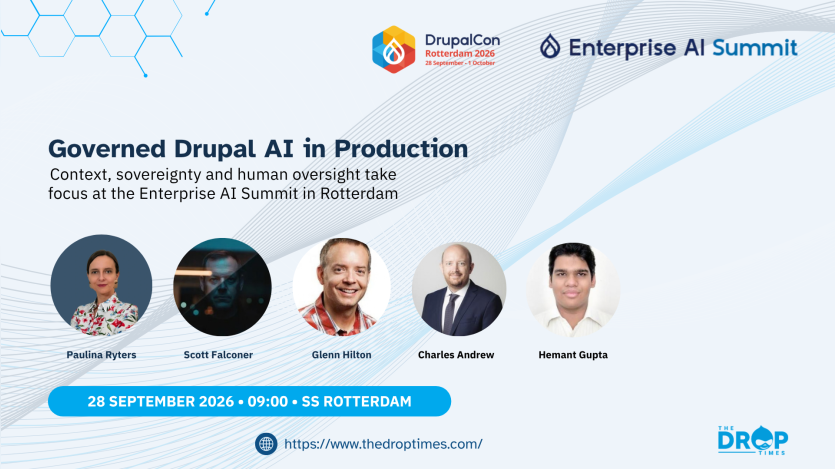
Speakers heading to the Enterprise AI Summit in Rotterdam are bringing Drupal AI cases shaped by source grounding, organisational context, human review and the constraints of existing enterprise systems. In responses provided to The DropTimes, Paulina Ryters-Menapace, Scott Falconer, Charles Andrew Revkin, Glenn Hilton and Hemant Gupta described work that moves the discussion beyond connecting a model to a website. Their examples cover multilingual candidate support, governed context for AI agents, AI-assisted user experiences, sensitive-content moderation and editorial workflows already using AI in production.
The common problem is governance rather than model capability alone. AI systems operating inside government, higher education, nonprofit and enterprise environments have to work with existing content, permissions, workflows, legal requirements, institutional knowledge and human decision-making. The cases differ substantially, but each puts control over information or decisions inside the implementation rather than treating governance as a separate compliance exercise.
The Enterprise AI Summit takes place on 28 September 2026 at the SS Rotterdam and is aimed primarily at senior digital and business decision-makers. Its programme places strategy and architecture ahead of hands-on coding, with sessions covering sovereignty, organisational context, AI-assisted user experiences, moderation and reported operational outcomes. Several sessions are built around systems already serving users rather than demonstrations or speculative product roadmaps.
Paulina Ryters-Menapace, chief commercial officer at Dropsolid, and Antonella Picarella, a senior Drupal developer working with the European Personnel Selection Office, are scheduled to present “Automating Candidate Support in 24 EU Languages: an EPSO Success Story” from 11:40 to 12:00 CEST. Their case concerns a retrieval-augmented AI answer engine deployed inside EPSO's existing Drupal platform across all 24 official European Union languages. The system retrieves information from approved institutional sources before generating responses, and the programme says every answer is cited back to the procedural material from which it was derived.
Paulina said the significance of the EPSO case is that candidates are already using the system under legal and procedural scrutiny. Results supplied for the session report 90% fewer repeat support questions, responses 30–50% faster for cases that still require human involvement, and no hallucinations identified during manual review. The programme also says the system was deployed in under eight weeks. Those figures remain project-reported results rather than independently audited measurements.
“It’s a real, live production case, not a demo or a slide deck of theory.”
Paulina identifies sovereignty and auditability as conditions that can enable AI adoption in regulated environments rather than simply constrain it. The EPSO implementation also provides an example of adding AI capabilities to an established Drupal platform without replacing the underlying system, while the same governed knowledge layer has been used internally to support staff onboarding.
Scott Falconer, senior director for Drupal, applied AI and agent success at Acquia, is scheduled at 14:10 CEST for “Context Is Your Business: Useful, Governed, and Actionable.” His argument is that enterprise AI becomes more useful when it can work with the information that distinguishes one organisation from another, including its customers, products, employees, decisions, workflows and institutional knowledge. Drupal enters that argument through structured content and controls around who can create, change, approve and access information.
“Context is one of the most important things when using AI.”
Scott's broader point is that Drupal's content structures and governance controls can help determine what organisational context agents receive and under what conditions. Structured content modelling, access control, editorial workflows and moderation can therefore become part of the context infrastructure used by AI assistants and agents.
Glenn Hilton, founder and CEO of ImageX, is scheduled at 14:30 CEST for “From Navigation to Assistance: How AI is Reshaping the User Experience of the Web.” His session uses an AI-powered admissions experience at the University of Waterloo to examine whether institutional websites change as users become accustomed to stating what they need and receiving direct assistance rather than navigating, searching and assembling information themselves.
“If AI can answer the question, why visit the website?”
Glenn uses that question to distinguish between adding AI to an existing website and reconsidering what an institutional digital experience is expected to do. That shift also increases the importance of trusted source content, governance and clarity about what an assisted system is authorised to tell a user.
World Cancer Day brings the governance question into a more sensitive setting. The current summit programme lists Charles Andrew Revkin, senior digital strategy manager at the Union for International Cancer Control, and Baddý Sonja Breidert, co-founder and CEO of 1xINTERNET, for “From Personal Stories to Global Impact: Scaling World Cancer Day with Drupal and AI” at 15:10 CEST. The programme says the Drupal-powered campaign currently has 1,215 published personal stories and handles traffic peaks above 500,000 requests per hour.
Charles said the team explored AI to help a comparatively small digital operation manage content discovery, user support, multilingual material and story moderation while keeping people central to the process. Current session material describes AI as supporting editorial review, accelerating processing and flagging edge cases rather than replacing human moderation. That distinction matters when submissions concern personal experiences of cancer and publication decisions require judgement about meaning, safety and context.
“I really look forward to hearing how others are turning AI from an interesting experiment into practical solutions that solve real problems.”
Charles's takeaways emphasise human oversight, trust and governance alongside the practical use of AI for content discovery, moderation and user support.
Hemant Gupta, technical architect at QED42, is scheduled at 13:50 CEST for the 20-minute case study “From Buzzword to Business Impact: How the American Diabetes Association Deployed AI on Drupal.” His session focuses on AI capabilities that reached editorial teams rather than remaining prototypes, including editorial assistance, bulk alt-text generation, in-editor AI tools and pipelines for moving Microsoft Word content into Drupal.
“Most AI talks are about what's possible. I wanted to talk about what we actually shipped.”
Hemant's takeaways centre on identifying which uses of AI delivered value inside the American Diabetes Association's content operation and which did not, how Drupal-based implementations can avoid unnecessary vendor lock-in, and why human review remains important when automated systems participate in editorial workflows.
The five highlighted sessions approach enterprise AI from different parts of the Drupal environment but repeatedly return to control over information, workflows and decisions. EPSO focuses on multilingual answers, source grounding, sovereignty and auditability; Scott examines governed organisational context; Glenn considers how assistance may change the role of websites; World Cancer Day explores automation around sensitive content while retaining human oversight; and Hemant examines which AI capabilities actually earn a place in day-to-day editorial work.
 Kazima AbbasKazima Abbas is a sub-editor at The Drop Times
ASK: Drupal Community Needs Your Support
View all →
Disclosure: This content is produced with the assistance of AI.
Note: The vision of this web portal is to help promote news and stories around the Drupal community and promote and celebrate the people and organizations in the community. We strive to create and distribute our content based on these content policy. If you see any omission/variation on this please reach out to us at #thedroptimes channel on Drupal Slack and we will try to address the issue as best we can.

Related Events
Enterprise AI Summit - Where Business Meets Innovation


Rotterdam, Netherlands
Related People


You may also like